
Can you improve confidence in football? Absolutely! Building confidence in football involves a blend of honing your skills on the pitch and cultivating a strong mental game. This comprehensive guide will explore proven strategies to boost your sports confidence, covering everything from practical practice drills for confidence to the nuances of performance psychology.
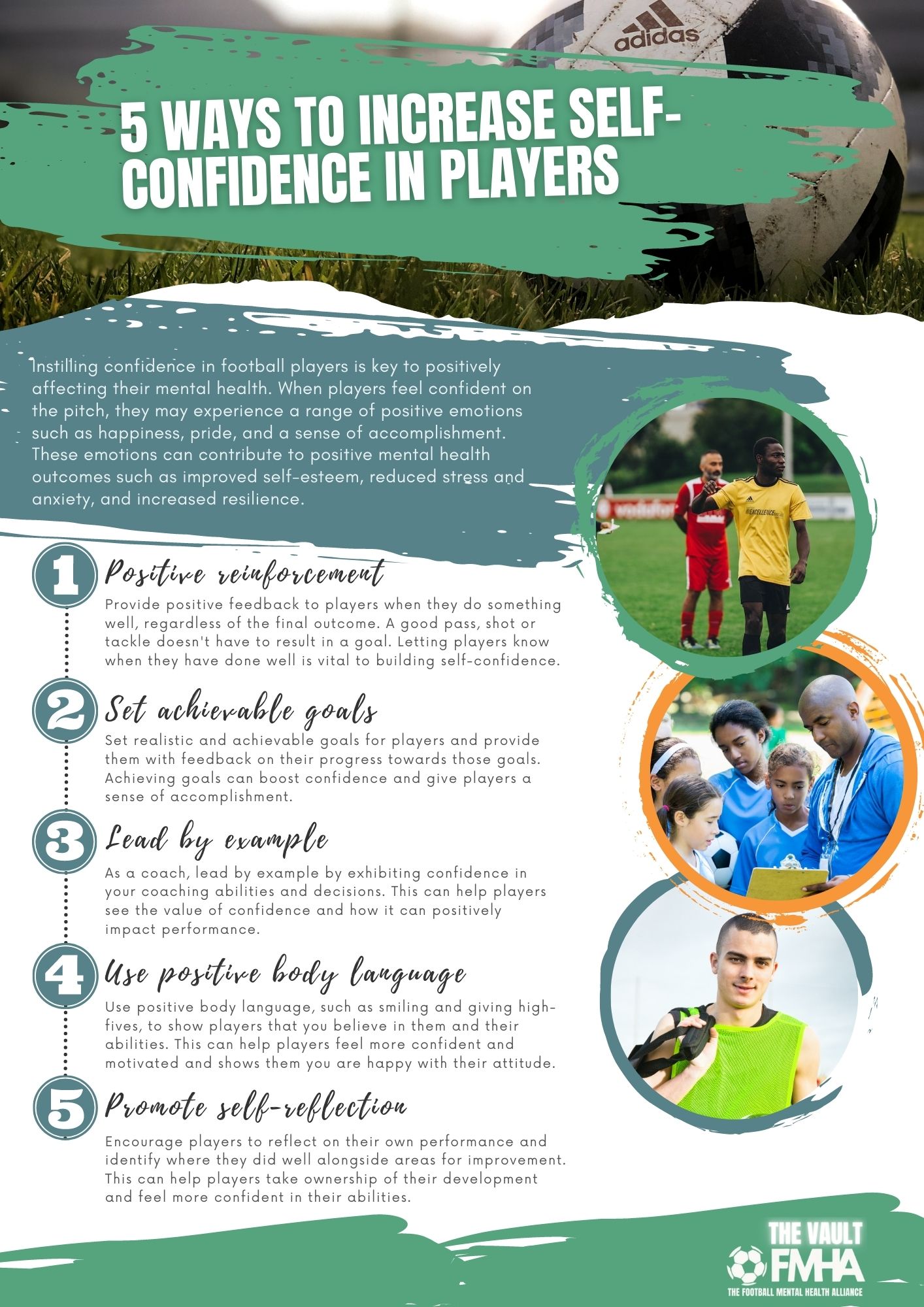
Image Source: vault.thefmha.com
Cultivating Unwavering Self-Belief
Self-belief is the bedrock of a confident footballer. It’s that inner voice that whispers, “I can do this,” even when facing tough opposition or after a mistake. Developing this crucial trait isn’t about being naturally gifted; it’s about conscious effort and consistent action.
The Power of Preparation
True self-belief stems from knowing you’ve done the work. When you’ve put in the hours on the training ground, your subconscious registers that preparedness. This translates to a feeling of readiness and competence when game time arrives.
- Consistent Training: Regular attendance and dedicated effort in every practice session are paramount.
- Targeted Skill Development: Focus on improving specific areas of your game, whether it’s passing accuracy, dribbling, or defensive positioning.
- Understanding Your Role: Knowing your responsibilities on the field and executing them effectively builds trust in your abilities.
Mastering Your Craft Through Practice Drills for Confidence
Specific practice drills for confidence are designed not just to improve technique, but also to build a positive feedback loop. Each successful repetition reinforces your capabilities.
Dribbling Confidence Builders
- Cone Weaving: Set up a series of cones and dribble through them at varying speeds. Focus on keeping the ball close and changing direction smoothly.
- Focus: Close control, agility.
- Progression: Add defenders (AI-controlled or teammates) to make it more game-like.
- Wall Passing Drills: Pass the ball against a wall and receive it back. Aim for crisp passes and clean first touches.
- Focus: Passing technique, first touch, receiving under pressure.
- Progression: Vary the distance and angle of your passes.
Passing and Receiving Drills
- Two-Touch Passing Circuit: Set up a circuit with teammates, focusing on quick, accurate passes and efficient receiving.
- Focus: Communication, accuracy, speed of play.
- Progression: Introduce a passive defender to create a slight challenge.
- Receiving on the Turn: Practice receiving passes with your body angled to turn quickly past an imaginary defender.
- Focus: Body shape, awareness, explosive first touch.
Shooting Drills for Confidence
- Stationary Ball Shooting: Place the ball stationary and focus on perfect striking technique, aiming for different parts of the goal.
- Focus: Ball striking, accuracy, power.
- Progression: Add a light jog to simulate receiving a pass before shooting.
- Cross and Shoot: Have a teammate deliver crosses from the wing, and practice attacking the ball and finishing.
- Focus: Timing, aerial ability, finishing under pressure.
Building Mental Toughness: The Core of Confidence
Mental toughness is your ability to persevere through adversity, maintain focus, and perform under pressure. It’s the inner strength that prevents a single mistake from derailing your entire game.
Developing Resilience in the Face of Setbacks
Building resilience means learning to bounce back from disappointments. Football is a game of errors; it’s how you respond that defines you.
- Viewing Mistakes as Learning Opportunities: Instead of dwelling on errors, analyze what went wrong and what you can do differently next time.
- Embracing Challenges: See difficult situations as chances to prove your capabilities rather than insurmountable obstacles.
- Positive Reinforcement: Acknowledge your successes, even small ones, to build a positive internal dialogue.
Overcoming Fear of Failure
The overcoming fear of failure is a common hurdle for many athletes. This fear can paralyze performance, making players hesitant to take risks or express their full abilities.
- Reframing Failure: Understand that failure is a part of the learning process, not a reflection of your worth.
- Focusing on Process, Not Just Outcome: Concentrate on executing your skills well, rather than solely on the result of a specific play.
- Incremental Goal Setting: Break down larger goals into smaller, achievable steps. Successfully completing these builds momentum and reduces the perceived risk of failure.
The Art of Positive Self-Talk
Positive self-talk is a powerful tool for influencing your mindset and, consequently, your performance. The words you use internally shape your beliefs about yourself and your capabilities.
Crafting Your Inner Dialogue
- Identify Negative Thoughts: Become aware of the self-critical thoughts that pop into your head.
- Challenge and Reframe: Question the validity of negative thoughts. Are they actually true? Replace them with more constructive and encouraging statements.
- Example: Instead of “I’m going to mess this up,” try “I’m prepared, and I’ll do my best.”
- Use Affirmations: Develop short, positive statements about your abilities and your game. Repeat them regularly.
- Affirmation Examples: “I am a skilled player.” “I contribute positively to the team.” “I have the ability to score.”
The Science Behind Self-Talk
Performance psychology offers insights into how our thoughts directly impact our actions. Research consistently shows that athletes who engage in positive self-talk tend to perform better, especially under pressure. This is because positive internal dialogue can:
- Reduce anxiety and stress.
- Increase focus and concentration.
- Enhance motivation and persistence.
- Improve mood and overall well-being.
Mastering Your Mind with Visualization Techniques
Visualization techniques are mental exercises that allow you to mentally rehearse successful actions and scenarios. By vividly imagining yourself performing optimally, you prime your brain and body for success.
How Visualization Works
When you visualize, you activate similar neural pathways as when you actually perform the action. This “mental practice” can improve:
- Motor Skill Acquisition: Visualizing correct technique can help in learning and refining movements.
- Confidence Building: Seeing yourself succeed repeatedly in your mind builds self-belief.
- Pressure Management: Mentally rehearsing how to handle specific game situations can reduce anxiety when they occur.
Practical Visualization Exercises
- Pre-Game Routine: Before a match, find a quiet space. Close your eyes and vividly imagine yourself:
- Making a crucial tackle.
- Executing a perfect pass.
- Scoring a goal.
- Celebrating a victory.
- Sensory Details: Engage all your senses – the roar of the crowd, the feel of the ball, the smell of the grass.
- Scenario Rehearsal: If you’re struggling with a particular aspect of your game, visualize yourself successfully performing it repeatedly.
- Example: If you miss penalties, visualize yourself stepping up, striking the ball cleanly, and seeing it hit the back of the net.
- Positive Outcome Focus: Visualize the entire game going well, focusing on your contributions and the team’s success.
Strategic Goal Setting for Confidence
Goal setting provides direction and purpose, transforming aspirations into actionable plans. Well-defined goals act as milestones, and achieving them significantly boosts confidence.
SMART Goals in Football
The SMART framework is a proven method for setting effective goals:
- Specific: Clearly define what you want to achieve.
- Bad Goal: “Get better at shooting.”
- Good Goal: “Score with a placed shot into the bottom corner from the edge of the box during training.”
- Measurable: How will you track your progress?
- Example: “Hit 8 out of 10 target areas with my passes in practice.”
- Achievable: Ensure the goal is realistic given your current abilities and resources.
- Example: If you’ve never scored from outside the box, aiming for 5 goals in one game might be too ambitious initially.
- Relevant: The goal should align with your overall aspirations as a footballer.
- Example: If you’re a defender, focusing on dribbling past three players might be less relevant than improving your interceptions.
- Time-bound: Set a deadline for achieving your goal.
- Example: “Improve my accuracy with crosses by 15% in the next month.”
Tracking Progress and Celebrating Milestones
- Keep a Journal: Document your goals, your progress, and how you feel about your achievements.
- Review Regularly: Look back at your goals and track how far you’ve come.
- Acknowledge Successes: When you achieve a goal, take a moment to appreciate your hard work. This reinforces your self-belief and motivates you to set new challenges.
The Mindset of a Champion: Key Principles
Adopting a champion’s mindset is crucial for sustained confidence and peak performance. It’s about how you approach challenges, learn from experiences, and maintain your drive.
Embracing Competition Positively
Competition is an inherent part of football. A confident player sees competition as an opportunity for growth, not a threat.
- Learn from Opponents: Study what makes good players effective and adapt those elements into your game.
- Focus on Your Performance: While aware of opponents, your primary focus should be on executing your own game plan to the best of your ability.
- Respect but Don’t Be Intimidated: Recognize the skill of others without letting it diminish your own perceived capabilities.
Handling Pressure Situations
Performance psychology highlights that pressure is often self-imposed. Learning to manage it is key.
- Breathing Techniques: Deep, controlled breathing can calm your nervous system and improve focus during high-pressure moments.
- Technique: Inhale slowly through your nose, hold for a few seconds, and exhale slowly through your mouth.
- Focus on the Present Moment: Avoid thinking about past mistakes or future consequences. Concentrate on the current play, the next pass, the next tackle.
- Positive Self-Talk: As discussed earlier, use your prepared affirmations and positive reframing to stay mentally strong.
The Importance of a Growth Mindset
A growth mindset, as coined by psychologist Carol Dweck, is the belief that your abilities can be developed through dedication and hard work.
- Challenges are Opportunities: People with a growth mindset see challenges as a chance to learn and grow, rather than a test of their innate abilities.
- Effort is the Path to Mastery: They understand that sustained effort is crucial for developing skills and achieving goals.
- Feedback is Valuable: They welcome constructive criticism as a tool for improvement.
- Success of Others is Inspiring: Instead of feeling threatened, they are inspired by the achievements of others.
Practical Application: Integrating Confidence into Your Game
Confidently applying your skills on the field requires a deliberate integration of your mental and physical preparation.
Pre-Game Rituals for Confidence
Establish consistent pre-game routines that prepare you mentally and physically. This could include:
- Specific warm-up exercises.
- Listening to motivating music.
- Reviewing your goal setting targets.
- Practicing visualization techniques.
- Engaging in positive self-talk.
On-Field Strategies to Maintain Confidence
- Positive Body Language: Stand tall, maintain eye contact, and move with purpose. Your body language communicates confidence to yourself and others.
- Communicate Effectively: Clear and confident communication with teammates fosters trust and reinforces collective strength.
- Embrace the “Next Play” Mentality: After a mistake, immediately shift focus to the next opportunity. Don’t dwell on what just happened.
- Celebrate Small Wins: A successful tackle, a well-placed pass, or a good defensive block – acknowledge and appreciate these moments.
Post-Game Analysis for Continued Growth
After a match, it’s crucial to analyze your performance constructively.
- Objective Assessment: Review what went well and what could be improved.
- Identify Confidence Boosters: What specific actions or moments during the game made you feel most confident? Try to replicate these.
- Plan for Improvement: Use the insights gained to refine your practice drills for confidence and mental strategies.
Common Confidence Killers and How to Combat Them
Even the most confident players can face moments of doubt. Recognizing and addressing these “confidence killers” is vital.
The Impact of Social Comparison
Constantly comparing yourself to teammates or opponents can be detrimental to your sports confidence.
- Focus on Your Journey: Remember that everyone has their own path and their own strengths.
- Use Comparison as Motivation, Not Demotivation: If you see a teammate excelling at something, use it as inspiration to improve in that area.
Dealing with Negative Feedback
Receiving criticism can be challenging, but it’s an inevitable part of sports.
- Filter Feedback: Discern between constructive criticism aimed at helping you improve and unhelpful negativity.
- Seek Clarity: If feedback is unclear, ask for specific examples or suggestions.
- Maintain Perspective: One piece of negative feedback doesn’t negate all your hard work and past successes.
Recovering from Poor Performances
A bad game can shake your confidence. Building resilience is key to bouncing back.
- Acknowledge, Don’t Dwell: Accept that it was a poor performance, but don’t let it define you.
- Focus on the Process: Recommit to your training and practice drills for confidence.
- Talk to a Coach or Mentor: Sometimes, an outside perspective can help you regain focus and motivation.
Frequently Asked Questions (FAQ)
How quickly can I improve my football confidence?
Confidence isn’t built overnight. It’s a gradual process. While you might notice improvements in weeks with consistent effort, developing deep-seated self-belief and mental toughness can take months or even years of dedicated practice and application of these strategies.
What’s the difference between confidence and arrogance?
Confidence is a quiet self-assurance based on preparation and capability. Arrogance is often an inflated ego, a need to appear superior, and can be a mask for underlying insecurity. Confident players are humble; arrogant players often aren’t.
Can I improve my confidence even if I’m not the most skilled player?
Absolutely. Skill and confidence are linked, but confidence is primarily a mental construct. Strong mental toughness, effective goal setting, and consistent positive self-talk can significantly boost the confidence of players at any skill level. Focus on maximizing your own abilities and effort.
How do I know if I’m using visualization techniques correctly?
You’ll know you’re using them effectively if you feel a sense of calm, readiness, and a heightened belief in your ability to perform after practicing them. The imagery should feel vivid and realistic, and it should evoke positive emotions. If you feel more anxious, you may need to adjust your approach.
What role does a coach play in building my confidence?
A good coach is invaluable. They can provide constructive feedback, set appropriate challenges, offer encouragement, and help you develop performance psychology strategies. Open communication with your coach about your confidence levels can lead to tailored support.
By consistently applying these principles of skill development and mental conditioning, any footballer can significantly improve their confidence and unlock their full potential on the pitch. Remember, confidence is not a given; it’s built.