
Yes, you absolutely can have an 11-team fantasy football league! While 10 or 12 teams are more common, an 11-man fantasy league is entirely feasible and can offer a unique and exciting fantasy football experience. This guide will walk you through everything you need to know about setting up and managing a fantasy football 11 teams league.
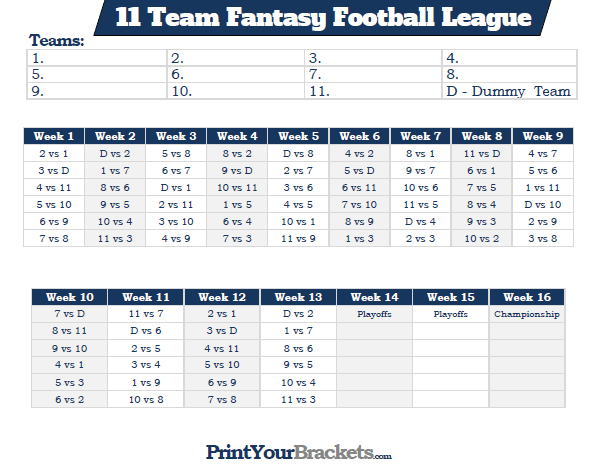
Image Source: www.printyourbrackets.com
Deciphering the 11-Team Landscape
Running an 11-team fantasy football league presents its own set of challenges and opportunities. It’s a sweet spot between the crowdedness of a 12-team league and the potential for top-heavy talent in smaller leagues. The key is to adapt your strategy and expectations to this slightly less conventional setup.
Why Choose an 11-Team League?
There are several good reasons why a group might opt for an 11-team fantasy league:
- Friend Group Size: Sometimes, an 11-team league perfectly accommodates the number of friends who want to play.
- Balanced Competition: It often strikes a good balance, preventing the league from becoming too diluted with talent (as can happen in larger leagues) while still offering good player availability.
- Unique Strategy: It forces managers to think differently about roster construction and waiver wire pickups.
Challenges to Expect in an 11-Team League
While manageable, an 11-team setup does have a few quirks:
- Player Pool Depth: The player pool will be slightly more stretched than in a 10-team league, but generally deeper than in a 12-team league. You’ll still find solid players available late in drafts.
- Waiver Wire: The waiver wire will be more active than in a 10-team league, requiring more diligent management.
- Bye Weeks: Managing bye weeks can be a bit trickier with an odd number of teams. You might have one less team active on any given Sunday compared to an even-numbered league.
Setting Up Your 11-Team League
The foundation of a successful 11-team fantasy football league is proper setup. This involves configuring your league settings to optimize the experience.
League Size and Structure
An 11-team league is straightforward in terms of size. The main consideration is how many players each team will roster. Standard NFL rosters are larger, but fantasy leagues typically focus on starting lineups plus bench depth.
Roster Sizes
Typical roster sizes for an 11-team fantasy football league might include:
- 1 Quarterback (QB)
- 2 Running Backs (RB)
- 2 Wide Receivers (WR)
- 1 Tight End (TE)
- 1 Flex (RB/WR/TE)
- 1 Kicker (K)
- 1 Defense/Special Teams (DST)
- Bench spots (typically 4-7)
This would bring a total roster size to 15-18 players. The exact number of bench spots can be adjusted based on league preference for roster management and waiver wire activity.
Scoring Settings
Scoring is crucial for any fantasy league. Common formats include:
- Standard: Basic scoring for touchdowns, yardage, and interceptions/fumbles.
- PPR (Point Per Reception): Awards a point for each reception, significantly boosting the value of pass-catching backs and slot receivers.
- Half-PPR: A middle ground, offering 0.5 points per reception.
- Custom Scoring: Leagues can also implement bonuses for long touchdowns, 100-yard games, etc.
For an 11-team league, PPR or Half-PPR are often favored as they increase the number of viable players and reward consistent volume.
Draft Type
The most common draft types are:
- Snake Draft: The draft order reverses each round. For an 11-team league, the order might be 1-11, then 11-1, then 1-11, and so on. This provides a slightly more balanced distribution of early and late picks.
- Auction Draft: Each team gets a budget to bid on players. This is an excellent format for 11-team leagues as it allows for more strategic roster building and can mitigate perceived draft order disadvantages.
Keeper/Dynasty Leagues
If your league is a keeper or dynasty league, the considerations for an 11-team format are similar to any other league size. The key is ensuring enough young talent remains available in drafts for new managers to build competitive teams.
Crafting Your 11-Team Fantasy Draft Strategy
The best 11-team fantasy draft is one that is well-prepared for. Your strategy needs to account for the slightly thinner player pool and the specific draft pick you have.
Pre-Draft Preparation for an 11-Man Fantasy League
Before the draft, you should:
- Research Rankings: Consult 11 team fantasy football rankings. These are often adjusted from 10 or 12-team rankings but will give you a good baseline.
- Mock Drafts: Participate in mock drafts with 11 teams to get a feel for player availability and ADP (Average Draft Position).
- Know Your League Settings: Understand your league’s scoring, roster requirements, and draft type inside and out.
Adapting to Your Draft Position
In a snake draft, your draft position is critical.
- Early Picks (1-3): You get two players back-to-back early. Aim for elite RBs or WRs. You can secure a strong foundation.
- Middle Picks (4-8): You often get picks at the turn (e.g., 4th and 14th overall). This is a good spot to grab two high-quality players.
- Late Picks (9-11): You get back-to-back picks at the end of rounds. This can be a double-edged sword. You might get two solid players, but the gap between your picks is longer.
Key Drafting Principles for 11-Team Fantasy Football
Here are some essential fantasy football draft strategy 11 teams tips:
- Target Value: Always draft the player with the highest value available relative to their draft position.
- RB Depth: Running backs can be volatile. Securing at least two reliable RBs early is often a good strategy, especially in an 11-team league where true bell-cows can be rare.
- WR Strength: Wide receiver depth is also important. Try to get at least two strong starters.
- Late-Round Sleepers: Identify players who are being undervalued and could outperform their draft position.
- Quarterback Strategy: In an 11-team league, you can often afford to wait on a QB if you’re strong at other positions. However, don’t wait too long, as the top-tier QBs will be gone.
- Tight End Value: The tight end position can be thin. If a top TE is available at a value, consider grabbing them. Otherwise, streaming TEs or finding a late-round gem is an option.
- Flex Flexibility: Having versatile players who can play multiple positions (RB, WR, TE) in your flex spot is invaluable.
11-Team Fantasy Football Strategy: Beyond the Draft
The draft is just the beginning. Managing an 11-team league effectively requires ongoing attention.
Waiver Wire Wizardry
The waiver wire is where many fantasy championships are won. In an 11-team league:
- Be Active: Claim players before they hit the waiver wire or before other managers can add them.
- Scout Ahead: Look for players with favorable upcoming schedules or potential breakout opportunities.
- Don’t Hold Onto Underperformers: If a player isn’t producing, be willing to cut them to pick up someone with higher upside.
Trade Negotiations
Trading is a vital part of fantasy football. In an 11-team league:
- Identify Needs: Understand your team’s strengths and weaknesses.
- Target Other Managers: Identify teams that might be willing to trade a player you need for one of your surplus players.
- Be Fair: While you want to win trades, offer fair value to keep your leaguemates engaged in trading.
Roster Management and Bye Weeks
With an odd number of teams, bye weeks can be managed. However, you’ll have one less team playing each week than in an even-numbered league.
- Plan for Byes: As bye weeks approach, ensure you have adequate depth at each position to cover your starters.
- Drop Unnecessary Players: Free up roster spots by dropping players who are unlikely to contribute.
11 Team Fantasy Football Tips for Success
Here are some specific 11 team fantasy football tips to keep in mind:
- Embrace Depth: While you want stars, don’t neglect depth at RB and WR, as injuries are inevitable.
- Monitor Player News: Stay updated on injuries, depth chart changes, and team news.
- Don’t Be Afraid to Take Risks: With a slightly thinner talent pool, sometimes a calculated risk on a high-upside player is necessary.
- Know Your Opponents: Pay attention to what other teams in your league are doing. This can inform your waiver wire and trade strategies.
- Have Fun! The most important tip is to enjoy the process and the competition.
Best 11-Team Fantasy Draft Picks to Target
While specific player rankings change weekly, here’s a general approach to target players:
Early Rounds (Rounds 1-3)
Focus on high-volume, elite players. In an 11-team league, you’ll likely see the top 8-10 RBs and WRs go off the board quickly.
- Anchor RB: Aim for a workhorse RB who gets significant carries and targets.
- Elite WR: Secure a receiver with high target share and touchdown potential.
- Tier 1 QB/TE: If a truly dominant QB or TE falls to you at a value, consider them.
Middle Rounds (Rounds 4-7)
This is where you build depth and find value.
- High-Upside WR2/RB2: Look for players who could finish as RB1s or WR1s on their teams.
- Handcuff RBs: Consider drafting the backup to your own star RB, or a high-upside backup to another team’s starter.
- Targeted TE/QB: If you missed out on the top tier, target a QB or TE in a strong offense.
Late Rounds (Rounds 8+)
This is where you find sleepers and fill out your roster.
- Handcuffs: Continue looking for backup RBs with standalone value.
- High-Upside WRs: Target receivers in potentially pass-heavy offenses or those with a clear path to targets.
- Kickers and Defenses: Draft these positions in the last two rounds unless your league settings dictate otherwise.
Sample 11-Team Fantasy Draft Strategy (Snake Draft Example)
Let’s say you have the 6th pick in a 10-team snake draft:
- Round 1 (Pick 6): Elite RB (e.g., Christian McCaffrey, Jonathan Taylor)
- Round 2 (Pick 17): High-end WR (e.g., Tee Higgins, Jaylen Waddle)
- Round 3 (Pick 30): Solid RB2 or another strong WR (e.g., Aaron Jones, Keenan Allen)
- Round 4 (Pick 41): QB or TE if a top option is available, otherwise a high-upside RB/WR (e.g., Lamar Jackson, Dallas Goedert, Rhamondre Stevenson)
- Round 5 (Pick 54): Focus on filling your flex position or securing depth at RB/WR.
- Round 6 (Pick 65): Continue building depth.
- Later Rounds: Focus on sleepers, handcuffs, and filling out your bench.
This strategy emphasizes securing talent early and then building depth and value as the draft progresses.
Fantasy Football Considerations 11 Teams: A Deeper Dive
When managing an 11-team league, several nuances come into play.
The Impact of the Odd Number of Teams
While not a major hurdle, the odd number means that each week, one team will be idle due to bye weeks. This is a minor point but something to be aware of when looking at league-wide scoring trends.
Player Pool Depth Analysis
In an 11-team league, the player pool feels deeper than in a 10-team league, especially in the middle rounds. However, it’s still not as deep as a 12-team league. This means that certain players who might be automatic starters in a 12-team league could be waiver wire fodder in an 11-team league.
- RB Availability: The top 20-25 RBs are usually drafted. After that, you’re looking at committee backs or players with less volume.
- WR Depth: Similar to RBs, the top 30-35 WRs are generally drafted. Beyond that, you’re looking at players with lower target shares or more competition.
- QB and TE: The top 12 QBs are typically drafted, and the top 8-10 TEs. This makes the TE position particularly crucial to address early if you want a reliable starter.
Managing Your Roster in an 11-Man League
Effective roster management is paramount:
- Don’t Hold Onto Dead Weight: Regularly review your bench. If a player has a very low ceiling or is injured with no clear return date, consider dropping them.
- Proactive Additions: Look at bye weeks 2-4 weeks in advance. If your starting RB or WR has a tough matchup or is on bye, start looking for replacements now.
- Trade for Needs: If you have a surplus at one position (e.g., three good RBs), don’t be afraid to trade one for a player you need at another position (e.g., a starting TE).
Frequently Asked Questions About 11-Team Fantasy Football
Q: Is an 11-team league too crowded?
A: No, an 11-team league is not too crowded. It offers a good balance between player availability and competitive depth. It’s a very manageable and enjoyable league size.
Q: How does an 11-team league affect draft strategy?
A: It means you need to be a bit more strategic with your picks, as the player pool is slightly thinner than in a 10-team league. Targeting value and securing depth, especially at RB and WR, is key.
Q: Are there specific 11 team fantasy football rankings I should use?
A: While general rankings are helpful, it’s beneficial to look for rankings that consider different league sizes. However, the core principles of player valuation remain the same. Adapt general rankings based on your league’s specific scoring and roster settings.
Q: How does an odd number of teams impact bye weeks?
A: It means one less team will be active each week compared to an even-numbered league. This doesn’t significantly alter strategy but is a minor consideration for league-wide player availability.
Q: What are the best roster sizes for an 11-man fantasy league?
A: A common and effective roster setup includes 1 QB, 2 RBs, 2 WRs, 1 TE, 1 Flex, 1 K, 1 DST, and 5-7 bench spots, totaling 15-18 players per team.
By following this guide, you’ll be well-equipped to set up, draft for, and manage a successful and exciting 11-team fantasy football league. The key is preparation, adaptation, and a willingness to engage with the waiver wire and trade market.