
What is a football pool? A football pool is a game where people bet on the outcome of a football game, usually the Super Bowl. Players purchase squares on a grid, and numbers are assigned to these squares. When the game is over, the numbers on the winning squares match the last digits of the scores for each team. This guide will show you how to make a football pool with 25 squares easily.
Creating a football pool, especially one with a 25-square grid, is a fantastic way to add excitement to game day, whether it’s a casual get-together with friends or a larger office pool. This method is straightforward, engaging, and perfect for a Super Bowl pool or any major football event. We’ll walk you through the entire process of making a squares grid, from drawing the board to managing the pool.
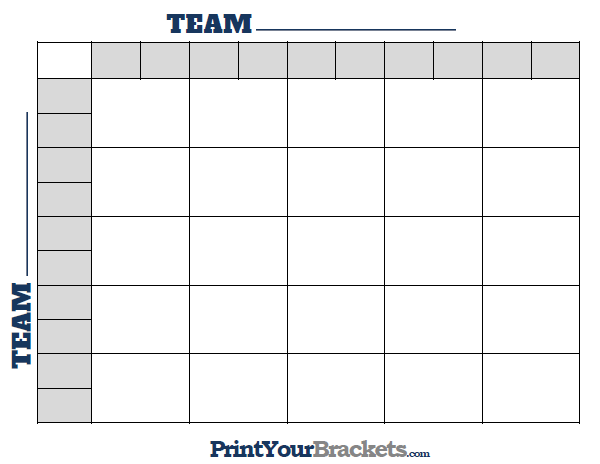
Image Source: www.printyourbrackets.com
Why Choose a 25-Square Grid?
A 25-square grid is a popular choice for a reason. It’s a manageable size that allows for a good number of participants without becoming overwhelming. It’s also easy to draw and fill. Unlike larger grids that can have complex scoring, a 25-square setup is simple to explain and manage. This makes it an ideal format for a betting pool among colleagues or friends.
Benefits of a 25-Square Football Pool:
- Simplicity: Easy to set up and play.
- Accessibility: Welcoming for both seasoned football fans and casual observers.
- Engagement: Keeps everyone invested in the game, from kickoff to the final whistle.
- Social: Great for parties and gatherings.
Steps to Creating Your 25-Square Football Pool
Here’s a detailed breakdown of how to make a football pool with 25 squares easily.
Step 1: Draw the Squares Grid
The first step is to create the physical or digital squares grid.
Making a Squares Board: The Physical Approach
- Materials: You’ll need a large piece of paper, poster board, or even a whiteboard. Markers of different colors are also helpful.
- Drawing the Grid:
- Draw a 5×5 grid. This means 5 rows and 5 columns.
- Each square within the grid represents a chance to win.
- Make sure the squares are large enough for people to write their names or initials.
- Labeling the Grid:
- Outer Labels: At the top of each column, write numbers 0 through 9. Do the same for the side of each row, again numbering 0 through 9.
- Important Note: You will have 10 numbers across and 10 numbers down, creating 100 possible combinations. However, for a 25-square grid, you will only use 5 of these columns and 5 of these rows. You can draw a full 10×10 grid and then simply fill in 25 squares, or you can draw a 5×5 grid directly. If you draw a 5×5 grid, you’ll need to decide which numbers (0-9) you want to assign to these rows and columns. A common approach is to use the numbers 0-4 for both rows and columns, or you can select 5 random numbers from 0-9 for each.
Making a Squares Board: The Digital Approach
You can easily create a squares grid using spreadsheet software like Microsoft Excel or Google Sheets.
- Open Spreadsheet Software: Start a new blank workbook.
- Create the Grid:
- Select 6 columns (A to F) and 6 rows (1 to 6).
- Adjust the column width and row height to make the cells square.
- Use the “Borders” tool to draw the grid lines. Select the cells and choose “All Borders.”
- Labeling the Grid:
- In cells B1 through F1, enter the numbers 0, 1, 2, 3, 4.
- In cells A2 through A6, enter the numbers 0, 1, 2, 3, 4.
- This creates your 5×5 squares grid. You can then copy this to create multiple boards or use it digitally.
Step 2: Determine the Cost Per Square
Decide how much each square will cost. This will depend on the number of participants and how much prize money you want to distribute.
- Example: If you want a total pot of $100 and each square costs $5, you’ll need 20 squares filled. For a 25-square grid, you could charge $4 per square ($4 x 25 = $100).
- Consider Prizes: Think about how the prize money will be distributed. Common payouts are for the score at the end of the 1st quarter, halftime, 3rd quarter, and final score. You can also have prizes for intermediate scores.
Step 3: Filling the Squares
Once the grid is ready and the cost is set, it’s time to fill the squares.
How to Fill the Squares:
- For a Small Group: The organizer can fill out the grid on behalf of everyone, collecting the money as they go.
- For a Larger Group (Office Pool): You can post the grid and have people sign up for squares. Keep a master list of who owns which square.
- Assigning Names: As people pay, write their name or initials in their chosen square.
Special Case: Random Number Assignment
If you want to make it fair and avoid people picking “their lucky numbers,” you can fill the squares randomly.
- Generate Numbers: Use a random number generator (online or by drawing numbers from a hat) to assign the digits 0 through 9 to the rows and columns. You’ll want to pick 5 unique digits for the rows and 5 unique digits for the columns.
- Draw Numbers for Squares: After all squares are sold, draw numbers from a hat (containing slips of paper numbered 0-9) for each row and column.
- Method 1 (Assigning Directly): Draw a number for each row (0-9) and then a number for each column (0-9). This will create a 10×10 grid. Then, you’ll need to select which 25 of those squares are active. For a 5×5 grid, you might select the squares where both row and column numbers are 0-4.
- Method 2 (For a 5×5 Grid Directly): Draw 5 numbers (0-9) for the rows and 5 numbers (0-9) for the columns. Assign these numbers to your 5×5 grid. For example, your rows might be 1, 3, 5, 7, 9 and your columns might be 0, 2, 4, 6, 8.
- Match to Score: The winning combination for each square will be the last digit of each team’s score at the end of a specific quarter. For instance, if Team A’s score is 14 and Team B’s score is 17, the winning square would be the one corresponding to the numbers 4 for Team A (row) and 7 for Team B (column).
Step 4: Set the Payouts
Decide on the prize structure. A common approach is to split the prize money across different scoring intervals of the game.
Common Payout Structures for a Football Pool:
- End of 1st Quarter: A set amount or percentage of the pot.
- Halftime (End of 2nd Quarter): A larger amount or percentage.
- End of 3rd Quarter: Another set amount or percentage.
- Final Score: The largest portion of the prize money.
Table: Example Payout Structure (25-Square Grid, $100 Pot)
| Scoring Interval | Payout | Percentage of Pot |
|---|---|---|
| End of 1st Quarter | $15 | 15% |
| Halftime | $25 | 25% |
| End of 3rd Quarter | $15 | 15% |
| Final Score | $45 | 45% |
| Total Prize Money | $100 | 100% |
- Alternative: You can also have a single payout for the final score, with the entire pot going to the person with the winning numbers at the end of the game.
Step 5: How to Run a Pool – Managing the Game
Effective pool management ensures a smooth and enjoyable experience for everyone.
Key Aspects of Pool Management:
- Clear Communication: Announce the cost per square, the payout structure, and the deadline for filling squares well in advance.
- Tracking: Keep a clear record of who has bought which squares. A shared spreadsheet or a well-maintained physical board works well.
- Number Assignment: If you are randomly assigning numbers, be transparent about the process.
- Score Updates: For larger groups, designate someone to track the scores and announce the winning numbers for each payout interval.
- Prize Distribution: Distribute the winnings promptly after the game concludes.
Tips for a Successful Office Pool:
- Keep it Casual: Avoid any pressure. It should be fun and voluntary.
- Anonymity (Optional): Some people prefer to use initials or pseudonyms.
- Technology: Utilize group chat apps or email for updates and announcements.
Popular Football Pool Variations
While the 25-square grid is a classic, there are other variations you might encounter or want to try.
The 100-Square Grid
This is the most traditional format for a football pool, especially for the Super Bowl.
- Setup: A 10×10 grid.
- Numbers: Columns and rows are numbered 0 through 9.
- Pros: Accommodates more people, more possible winning combinations.
- Cons: Can be more complex to fill and manage for smaller groups.
Smaller Grids (e.g., 10 or 16 Squares)
For very small groups, you might opt for a 3×3 (9 squares) or 4×4 (16 squares) grid. The principles remain the same, but you’ll adjust the number assignment and payouts accordingly.
Frequently Asked Questions About Football Pools
Here are some common questions about setting up and running a football pool.
Q1: What is the most common way to assign numbers in a football pool?
A1: The most common method is to assign numbers 0-9 to both the rows and columns. Then, players choose squares on a grid. The winning numbers for each payout interval are the last digits of each team’s score at that specific time in the game. For a 25-square grid, you can limit the numbers used to 0-4 for both rows and columns or select 5 random numbers from 0-9 for each.
Q2: How much should I charge for a square?
A2: This depends on your desired total prize pool. Divide the total prize pool by the number of squares. For a 25-square grid, if you want a $100 prize pool and charge $4 per square, you’ll collect $100 ($4 x 25).
Q3: Can I run a football pool for an office?
A3: Yes, you can certainly run an office pool. Ensure it’s clear that participation is voluntary and that it complies with any company policies regarding gambling or betting.
Q4: What are the winning numbers based on?
A4: The winning numbers are determined by the last digit of each team’s score at specific points in the game (e.g., end of the first quarter, halftime, end of the third quarter, and the final score). For example, if the score is Team A 17, Team B 14, the winning square would be the one with Team A’s number ending in 7 and Team B’s number ending in 4.
Q5: How do I handle ties in a football pool?
A5: If multiple people have the winning numbers for a specific payout interval, the prize money for that interval is usually split equally among them. Alternatively, you can have a drawing to determine a single winner, but splitting is more common.
Q6: What if a game has a very low score, like 0-0?
A6: In such cases, the numbers 0 are used. If the score is 0-0, the person with the 0 for Team A and 0 for Team B wins that payout.
Q7: Can I use a digital tool to manage my football pool?
A7: Absolutely! Spreadsheet software, dedicated pool management websites, or even simple online forms can help with tracking participants, squares, and payouts.
Final Thoughts on Making Your Football Pool
Creating a 25-square football pool is a fun and easy way to enhance your game-day experience. By following these steps, you can easily set up your squares grid, manage participants, and ensure everyone has a chance to win. Whether it’s a casual Super Bowl party or a regular office pool, this classic game structure is sure to be a hit. Enjoy the game and good luck with your football pool!