
Can you wear football cleats for baseball, or vice versa? While both are types of cleated athletic shoes designed for traction, football and baseball cleats possess distinct differences in their design, stud patterns, and overall construction, making them specialized footwear optimized for the unique demands of each sport. Attempting to use one for the other can lead to reduced performance, increased risk of injury, or even damage to the footwear itself.
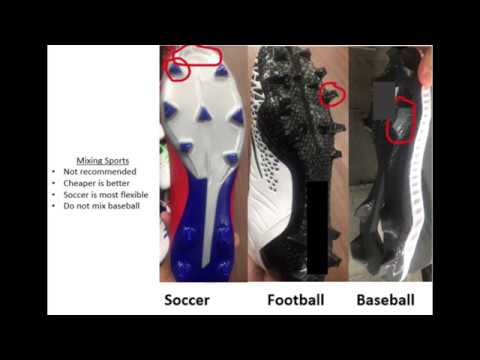
Image Source: i.ytimg.com
Deciphering the Cleats Difference: Football vs. Baseball Shoes
At first glance, football and baseball cleats might appear similar – both have spikes or studs on the sole to grip the playing surface. However, a closer examination reveals significant variations. These sports-specific designs are crucial for enhancing player agility, preventing slips, and providing the necessary support for explosive movements. This detailed comparison will help you pinpoint the key features that distinguish football vs. baseball shoes and guide you in identifying cleats difference.
Cleat Anatomy: A Look at the Soles
The most apparent differences lie in the cleat anatomy, specifically the configuration and type of studs. Understanding these variations is fundamental to comprehending the sports shoe differences between these two athletic disciplines.
Football Cleats: Power and Propulsion
Football cleats are engineered for bursts of speed, sharp lateral movements, and powerful acceleration. The stud patterns are designed to maximize grip in various conditions, from dry turf to muddy fields.
- Stud Types:
- Molded Cleats: These are permanently attached to the shoe’s sole and are typically made of rubber or plastic. They offer good traction on most surfaces and are generally more comfortable and durable. Many youth football leagues only allow molded cleats.
- Detachable Cleats: These cleats screw into a base plate on the sole, allowing players to customize their stud length and material based on field conditions. Metal cleats, a type of detachable cleat, offer superior grip but are often prohibited on artificial turf and in lower-level leagues due to safety concerns.
- Stud Placement and Design:
- Forefoot Emphasis: Football cleats often feature a more aggressive stud pattern on the forefoot to provide traction for quick starts and directional changes. You’ll frequently see longer, more prominent studs here.
- Heel Support: While the forefoot is key for propulsion, the heel also has studs for stability during braking and cutting.
- Midsole Cleats: Some football cleats include cleats in the midfoot area, which aid in lateral stability and prevent slippage during sharp turns.
- Blade Cleats: These are flat, rectangular studs that provide excellent lateral grip and are often found on the edges of the sole, particularly in the forefoot.
- Conical Cleats: These are cone-shaped studs that offer good all-around traction and are helpful for rotational movements.
- Upper Construction: Football cleats often have a higher ankle collar (high-top) for added ankle support, which is vital for absorbing impact and preventing sprains during collisions and quick pivots. The uppers are typically made from durable synthetic leather or mesh, designed to withstand the rigors of the game.
Baseball Cleats: Agility and Base Running
Baseball cleats are built for the specific movements of the game: sprinting, shuffling, quick changes in direction on dirt and grass, and rotational force during batting and pitching.
- Stud Types:
- Molded Cleats: Similar to football, molded cleats are common in baseball, especially for younger players or on softer surfaces. They are usually made of rubber.
- Metal Cleats: These are the most common type of cleat used by adult baseball players. Metal cleats offer superior penetration into the dirt and grass, providing the best grip for explosive movements like stealing bases and rounding corners. However, they can be less comfortable and are banned on some artificial turf fields.
- Detachable Cleats: Baseball also utilizes detachable cleats, allowing players to swap metal or molded studs to suit field conditions.
- Stud Placement and Design:
- Toe Cleat: A distinctive feature of many baseball cleats is a cleat located on the toe of the shoe. This is crucial for batters as it provides traction for rotational power during swings and for pitchers during their delivery.
- Circular or Jagged Studs: Baseball cleats often feature circular or jagged-edged studs that allow for easier rotation of the foot, which is important for batters and fielders.
- Even Distribution: While there’s still a focus on the forefoot for acceleration, baseball cleats tend to have a more evenly distributed stud pattern across the sole compared to the concentrated forefoot grip in football. This supports the varied directional changes and lateral movements needed on the baseball diamond.
- Heel Studs: Heel studs in baseball are typically designed for stability during pitching and rounding bases.
- Upper Construction: Baseball cleats typically have a lower ankle cut (low-top or mid-top) to allow for greater ankle flexibility, which is essential for the agility required in fielding, batting, and base running. The uppers are often made from synthetic materials or leather, with some designs incorporating mesh for breathability.
Identifying Football Cleats: Key Features
When you’re identifying football cleats, look for these distinguishing characteristics:
- High-Top Design: A significant number of football cleats feature a high-top collar to provide substantial ankle support. This is a primary indicator.
- Aggressive Forefoot Studs: Notice the arrangement of studs. Football cleats often have longer, more prominent studs concentrated on the front of the shoe, designed for powerful forward momentum.
- Blade Studs: The presence of flat, rectangular “blade” studs, particularly along the edges of the sole, is a strong indicator of football footwear.
- Midfoot Studs: Some football cleats have studs positioned in the middle of the sole, which aren’t as common in baseball cleats.
- Heavier Construction: Generally, football cleats tend to be more robust and may feel heavier due to their emphasis on durability and protection for high-impact play.
Identifying Baseball Cleats: Key Features
To effectively distinguish identifying baseball cleats, focus on these elements:
- Toe Cleat: The most definitive sign of a baseball cleat is a stud or cleat located at the very tip of the toe. This is virtually absent in football cleats.
- Lower Ankle Collar: Most baseball cleats are low-top or mid-top, prioritizing ankle flexibility over extreme support.
- Circular/Jagged Studs: Observe the stud shapes. Baseball cleats often utilize more rounded or somewhat jagged studs that facilitate easier foot rotation for batters and fielders.
- Evenly Spaced Studs: While there’s still grip emphasis, the stud pattern tends to be more evenly distributed across the sole, supporting a wider range of movements.
- Lighter Build: Baseball cleats are often lighter than football cleats, aiding in speed and agility for base running and quick fielding plays.
Cleat Comparison: A Table of Differences
To further clarify the distinctions, here’s a direct cleat comparison:
| Feature | Football Cleats | Baseball Cleats |
|---|---|---|
| Primary Purpose | Power, acceleration, lateral stability, impact | Speed, agility, rotation, grip on dirt/grass |
| Ankle Collar | High-top (most common) for maximum support | Low-top or Mid-top for flexibility |
| Stud Location | Concentrated on forefoot, some midfoot | Evenly distributed, prominent toe cleat |
| Stud Shape | Blades, cones, aggressive patterns | Circular, jagged, rounded, designed for rotation |
| Stud Material | Molded (plastic/rubber), Detachable (metal/plastic) | Molded (rubber), Detachable (metal/rubber) |
| Toe Cleat | Absent | Present (a defining characteristic) |
| Weight | Often heavier, more robust | Generally lighter, prioritizing speed |
| Upper Material | Durable synthetics, leather, mesh | Synthetics, leather, mesh, often with reinforced toe area |
| Intended Surface | Grass, turf, sometimes dirt | Dirt, grass, sometimes turf (with molded cleats) |
Fathoming the Functional Variations: Why the Differences Matter
The sports shoe differences are not merely cosmetic; they are directly tied to the biomechanics and physical demands of each sport. Using the wrong type of cleat can hinder performance and create safety hazards.
Performance Implications
- Football: The aggressive forefoot studs and often stiffer sole plate of football cleats provide the traction needed for explosive initial steps and cutting maneuvers. The enhanced ankle support helps prevent injuries during high-impact collisions and tackles.
- Baseball: The toe cleat is vital for batters generating torque and for pitchers maintaining balance. The stud patterns designed for rotation allow players to pivot effectively without getting stuck, crucial for hitting and fielding. The lighter weight contributes to faster base running and quicker movements in the field.
Safety Concerns
- Using Football Cleats for Baseball: The prominent forefoot studs on football cleats can dig too deeply into the dirt or turf, potentially causing a player to catch their foot and twist an ankle or knee. The stiffer sole can also limit the necessary ankle flexibility for baseball movements. Furthermore, metal football cleats, if allowed, can be excessively damaging to turf fields and pose a greater injury risk on impact.
- Using Baseball Cleats for Football: Baseball cleats, particularly metal ones, typically lack the robust ankle support that football players need. The stud pattern, especially the toe cleat, is not designed for the same kind of lateral impact and powerful pushes that occur in football. This can lead to reduced traction for starting and stopping, increased risk of ankle sprains due to less support, and potential damage to the cleats themselves from the sheer force of football plays.
Specialized Footwear: Beyond the Basic Cleat
The concept of specialized footwear is paramount in understanding why these distinctions exist. Both football and baseball cleats are examples of how athletic shoe design is tailored to optimize function and safety for specific sports.
Evolution of Cleat Technology
Over the years, cleat technology has evolved significantly. Manufacturers continuously research player biomechanics and field conditions to develop innovative designs. This includes:
- Material Science: Advances in lightweight, durable synthetic materials and cushioning technologies have made cleats more comfortable and responsive.
- Stud Design: Experimentation with different stud shapes, lengths, and configurations aims to provide the optimal grip for various playing surfaces and movements.
- Fit and Support: Ergonomic designs, improved lacing systems, and advanced ankle support structures contribute to better performance and injury prevention.
Considering the Playing Surface
The type of playing surface is another critical factor influencing cleat design.
- Natural Grass: Both sports are played on natural grass, but the specific wear patterns and moisture levels can vary.
- Artificial Turf: Modern artificial turf fields have unique properties. Molded cleats are generally recommended for artificial turf to prevent snagging and reduce the risk of lower leg injuries. Metal cleats are almost universally prohibited on turf. The stud pattern also needs to be considered, as some turf-specific cleats have shorter, more numerous studs to distribute pressure.
- Dirt Fields (Baseball): The loose, gritty nature of baseball infields and warning tracks necessitates cleats that can dig in effectively, which is where metal cleats often excel.
Common Misconceptions and FAQs
Addressing common questions helps solidify the cleat comparison and the rationale behind the design differences.
Frequently Asked Questions (FAQ)
Q1: Can I wear football cleats for baseball?
A1: While it might be possible in a pinch, it is not recommended. Football cleats often have aggressive forefoot studs that can cause you to catch your foot in the dirt, increasing the risk of ankle or knee injuries. They also generally offer more ankle support, which can restrict the flexibility needed for baseball movements.
Q2: Can I wear baseball cleats for football?
A2: No, this is generally a bad idea. Baseball cleats, especially metal ones, lack the necessary ankle support for the high-impact nature of football. The toe cleat can also be a hazard. Furthermore, the stud pattern isn’t designed for the explosive lateral cuts and direct tackles common in football, potentially leading to reduced performance and an increased risk of injury.
Q3: Are metal cleats better than molded cleats?
A3: Metal cleats offer superior traction, especially on softer natural grass and dirt surfaces, making them ideal for adult baseball players who need maximum grip for speed and rotation. However, molded cleats are more versatile, safer for younger players, generally more comfortable, and are usually the only option for artificial turf.
Q4: What are blade cleats?
A4: Blade cleats are flat, rectangular studs typically found on the edges of football cleats. They are designed to provide excellent lateral grip for cutting and changing direction.
Q5: Why do baseball cleats have a toe cleat?
A5: The toe cleat is a crucial feature in baseball cleats, providing essential traction for batters during their swing and for pitchers during their stride. It helps generate rotational force and maintains stability.
Q6: Is there a significant weight difference between football and baseball cleats?
A6: Generally, football cleats tend to be heavier and more robust to provide better support and durability for the sport’s high-impact nature. Baseball cleats are often lighter to enhance speed and agility for base running and fielding.
Q7: What is the purpose of high-top cleats?
A7: High-top cleats are designed to offer enhanced ankle support and stability. This is particularly important in sports like football, where players are subject to forceful tackles, collisions, and sudden directional changes that can put stress on the ankles.
Q8: Are there cleats suitable for both football and baseball?
A8: No single cleat is truly optimized for both sports. While some molded cleats might be used in a pinch for casual play in either sport, the specialized designs for each game are quite distinct and serve different functional purposes. Using the correct specialized footwear is always recommended.
By paying close attention to the cleat anatomy, stud patterns, ankle collar height, and overall construction, you can confidently distinguish between football and baseball cleats, ensuring you choose the appropriate footwear for your athletic endeavors. This detailed cleat comparison highlights the specific engineering that goes into each type of athletic shoe, making them effective for their intended sports.