
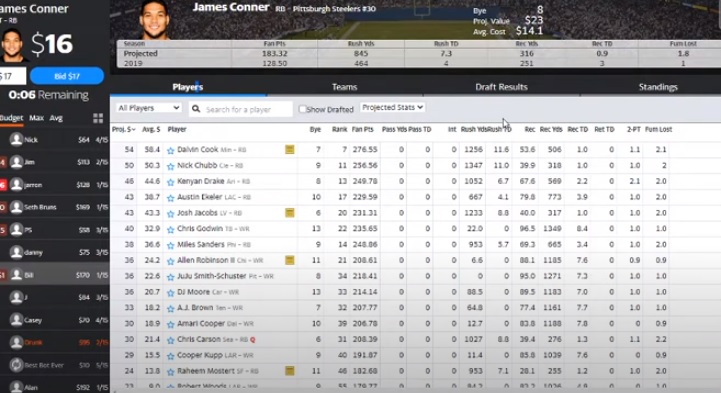
Image Source: footballabsurdity.com
How To Do Fantasy Football Auction Draft: Winning Strategy
What is a fantasy football auction draft? A fantasy football auction draft is a draft format where each team owner has a fixed budget (usually $200) to bid on players. Unlike snake drafts, players are nominated one by one, and owners bid against each other until no one else is willing to spend more. The highest bidder wins the player. Can you win a fantasy football auction without overpaying? Absolutely. This guide will break down how to do fantasy football auction drafts and implement winning strategies.
Mastering the Auction: Your Blueprint for Fantasy Football Triumph
Fantasy football auction drafts offer a dynamic and often more strategic alternative to traditional snake drafts. They test your financial acumen, player knowledge, and nerve. Unlike the predetermined order of snake drafts, auctions put you in direct competition for every player you desire. This guide will equip you with the essential knowledge and fantasy football auction strategy to navigate the bidding wars and emerge victorious. We’ll cover everything from pre-draft preparation to in-draft tactics and post-draft analysis.
Pre-Draft Preparation: Laying the Foundation for Success
Success in an auction draft doesn’t begin when the first player is nominated; it starts long before. Thorough preparation is paramount to executing your fantasy football auction draft guide.
1. League Rules and Settings Analysis
Before you even think about player rankings, dive deep into your league’s specific rules. These are the bedrock of your strategy.
- Budget: What is the total budget? Is it standard ($200) or something different?
- Roster Size and Positions: How many players will you draft? What are the required starting positions (QB, RB, WR, TE, Flex, K, DST)?
- Scoring System: This is crucial. PPR (Point Per Reception) leagues heavily favor pass-catching running backs and high-volume wide receivers. Standard scoring might place more value on touchdowns. Understand how many points are awarded for different actions (passing yards, rushing yards, touchdowns, receptions, etc.).
- Keeper Rules: If your league has keeper rules, this drastically impacts player values. Do you keep players for a reduced budget, or does it cost a specific round pick?
- Waiver Wire Rules: Knowing how active the waiver wire is can influence how aggressively you pursue depth players.
2. Creating Your Auction Draft Player Rankings and Values
This is where the real work begins. Your fantasy football auction values should be more granular than typical snake draft rankings. You need to assign a dollar amount to each player.
Developing Your Player Tiers
A tiered approach is essential for auction drafts. Instead of just a linear ranking, group players into tiers based on their projected fantasy points and perceived value.
- Tier 1: Elite/Must-Have Players: These are the undisputed top-tier players who can anchor your team. They will command the highest prices.
- Tier 2: High-End Starters: Excellent players who might not be elite but provide significant fantasy production.
- Tier 3: Solid Starters/High Upside: Players who are reliable starters with the potential to outperform their draft cost.
- Tier 4: Depth/Potential Breakouts: Players who could emerge as valuable assets or provide crucial depth.
- Tier 5: Lottery Tickets/Deep Sleepers: Players with very little projection but who might surprise.
Assigning Dollar Values
Once you have tiers, assign a dollar value to each player. This is not an exact science, but a relative guide.
- Top Players: Assign the highest values to your top 3-5 players. Consider their positional scarcity and overall projected output.
- Positional Scarcity: Quarterbacks and Tight Ends are often less scarce than elite Running Backs and Wide Receivers. This means you can often find a solid QB or TE later in the draft, allowing you to spend more on RB/WR. However, if your league heavily favors QB scoring, this can shift.
- Value Beyond Top Tiers: Players in lower tiers should have significantly lower dollar values. You want to identify players who are undervalued based on their potential.
- Flexibility: Your dollar values are guidelines, not rigid rules. Be prepared to adjust based on how the auction unfolds.
Example: Sample Player Value Ranges (for a $200 budget league)
| Tier | Players (Example) | Value Range | Notes |
|---|---|---|---|
| Tier 1 Elite | Christian McCaffrey, Justin Jefferson | $70-$90 | Franchise-altering players, expect them to be highly contested. |
| Tier 2 High-End | Ja’Marr Chase, Travis Kelce, Austin Ekeler | $45-$65 | Elite options at their position, capable of winning weeks. |
| Tier 3 Solid Starters | CeeDee Lamb, Derrick Henry, Mark Andrews | $25-$40 | Reliable producers, the backbone of most fantasy teams. |
| Tier 4 Depth/Upside | George Pickens, Rachaad White, Dalton Kincaid | $10-$20 | Good value picks with potential to outperform their cost or provide solid bye-week fill-ins. |
| Tier 5 Lottery Tickets | Rookies with potential, players returning from injury | $1-$5 | High risk, high reward. You might get a steal. |
Utilizing Pre-Draft Resources
Don’t reinvent the wheel entirely. Leverage reputable fantasy football sites for their auction draft player rankings and dollar value projections. However, always adjust these based on your league’s specific settings and your own analysis.
3. Budget Management Strategy: The Heart of the Auction
This is arguably the most critical element of budget management fantasy football. You need a plan for how you’ll allocate your $200.
- The “Stars and Scrubs” Approach: This strategy involves spending a significant portion of your budget on a few elite players and then filling the rest of your roster with cheaper, high-upside players.
- Pros: Can create a very strong starting lineup.
- Cons: Leaves little room for depth and can be risky if your top players get injured.
- The “Balanced” Approach: This strategy aims for a more even distribution of your budget, acquiring solid starters at each position without breaking the bank on any single player.
- Pros: More depth, less reliance on a few players.
- Cons: Might miss out on the truly elite players.
- The “Value Hunting” Approach: Focus on identifying players who are consistently going for less than their projected value. This requires meticulous research and an ability to identify undervalued talent.
- Pros: Can lead to tremendous value and a deep roster.
- Cons: Requires constant vigilance and risk tolerance.
Determining Your Spending Allocation
A common approach is to break down your budget by position. This is a flexible guide, not a rigid rulebook.
- Quarterback: $5-$20 (unless you’re in a 2-QB or Superflex league, then significantly more)
- Running Backs: $40-$70 (often the most expensive position due to scarcity)
- Wide Receivers: $40-$70 (can also be expensive, especially in PPR)
- Tight End: $10-$25 (unless there’s a clear top-tier option you desperately want)
- Flex/Bench: $20-$40 (for depth and upside)
- Kicker/Defense: $1-$5 (typically drafted last, very little allocated here)
Key Budget Management Principles:
- Don’t Blow Your Budget Early: Resist the urge to overspend on the first few players nominated. Save your money for players you truly covet or when your specific needs arise.
- Know When to Stop Bidding: Set a maximum price for each player you are targeting and stick to it. Don’t get caught in a bidding war that derails your entire strategy.
- Leave Room for the Unexpected: You might find a player you didn’t anticipate being available at a great price, or you might have to overspend on a position you thought you could wait on.
In-Draft Execution: Navigating the Auction Floor
Your preparation is complete; now it’s time to implement your best auction draft approach. This requires focus, discipline, and a keen eye on the flow of the draft.
1. Nomination Strategies: Controlling the Draft Flow
Auction draft nomination strategies are your primary tool for influencing who is drafted and when.
- “Rattling the Chains” (Nominating Expensive Players Early): Nominate a few of the top-tier players early, even if you don’t necessarily want them. This can force other owners to spend their budgets quickly, potentially leaving them short for later rounds.
- “Positional Dumping”: If you’ve already secured your target players at a certain position, consider nominating a mid-tier player at that position to force others to spend money there.
- “Targeted Nominations”: Nominate players you desperately need or players you know other owners are targeting. This forces them to spend money or miss out.
- “Surprise Nominations”: Nominate players who are generally considered less valuable but have a specific role or upside that might appeal to a particular owner.
- “Weak Link Nomination”: Nominate players at positions where you are strong and you believe other owners are weak. This can force them to overspend to fill a roster spot.
2. The Art of Bidding: Smart Spending, Not Just Spending
Bidding is where your fantasy football auction strategy comes to life.
- “The Quick Bid”: When a player you like is nominated, place a bid slightly above the perceived value to signal your interest and potentially scare off weaker contenders.
- “The Wait-and-See”: For players you like but aren’t essential, wait to see how the bidding develops. You might get them for a bargain.
- “The Mid-Bid Counter”: If a bidding war erupts, consider placing a bid that’s not the absolute highest but still competitive. This can force the determined owner to spend more.
- “The Zero-Bid Approach”: Sometimes, it’s better to not bid at all if a player is going for significantly more than your valuation. Don’t get emotional.
- “The Pump Fake”: Make a few small bids on players you don’t necessarily want to give the impression you’re spending freely, but then pivot and save your money.
Reading Your Opponents
Pay attention to how much money each owner has left and what positions they still need. This information is gold.
- Who is running low on cash? They become less of a threat for premium players.
- Who desperately needs a QB? They’ll likely overspend at that position.
- Who has a lot of money left? They could be a dangerous late-round threat.
3. Identifying Value and Avoiding Overpays
This is the essence of winning an auction draft.
- Target Undervalued Players: Focus on players who are projected to score well but are being drafted for less than your calculated value. These are your potential league-winners.
- Recognize Positional Scarcity: If elite players at a certain position are flying off the board, the remaining players at that position will command higher prices. Be ready to adapt if your target is suddenly much more expensive.
- Don’t Chase Players: Stick to your plan. If a player you love is going for double your allocated amount, let them go. There will be other opportunities.
- The “Cornerstone” Player: Identify one or two players you are willing to spend a significant portion of your budget on to anchor your team. These are players who can consistently produce at a high level.
4. Filling Out Your Roster: Depth and Upside
Once you’ve secured your core players, focus on building depth and acquiring players with breakout potential.
- Target High-Upside Bench Players: These are players who could step into a starting role due to injury or poor performance from the starter ahead of them.
- Don’t Neglect Kicker and Defense: While you shouldn’t overspend, don’t forget these spots. You can typically grab a solid kicker and defense in the final minutes of the auction for very little.
- Consider Bye Weeks: While not as critical as in snake drafts, be mindful of byes, especially for your QB.
Post-Draft Analysis and Adjustments
The auction is over, but your work isn’t quite done. A quick review can solidify your team and prepare you for the season.
1. Reviewing Your Draft Results
- Compare Your Team to Your Plan: Did you stick to your budget? Did you secure the players you targeted?
- Identify Strengths and Weaknesses: Where are you deep? Where are you thin?
- Analyze Opponent Rosters: Who got great value? Who overpaid? This can inform your waiver wire strategy throughout the season.
2. Waiver Wire and Trade Strategies
Your draft is just the beginning. The waiver wire and trades are where you continue to refine your roster.
- Target Key Players: If you missed out on a certain player type (e.g., a pass-catching RB), prioritize acquiring one via the waiver wire or trade.
- Stay Active: Be ready to pick up breakout players or fill in for bye weeks.
Frequently Asked Questions (FAQ)
Q: How much should I spend on a top-tier player in a $200 auction?
A: Typically, elite players might go for $60-$90+. It depends on their positional scarcity and your league’s scoring. Don’t be afraid to spend if they fit your strategy, but know your limit.
Q: What if all the players I want are going for too much?
A: This is where discipline comes in. Don’t chase players. Be prepared to pivot to your next targets. The beauty of an auction is that there are always opportunities to find value.
Q: How do I handle drafting a QB in an auction?
A: In single-QB leagues, you often don’t need to overspend on a QB. You can wait and find a solid starter with a much lower price tag. In Superflex or 2-QB leagues, QBs become incredibly valuable and will command higher bids.
Q: When should I start bidding aggressively?
A: Bid aggressively on players you have identified as cornerstones of your team and who offer significant value at their projected price. Also, consider bidding aggressively if you see a clear positional advantage you can exploit.
Q: What are some common auction draft mistakes to avoid?
A: Overspending early, getting emotional in bidding wars, not having a budget, not researching player values, and neglecting roster depth are all common mistakes.
By focusing on thorough preparation, disciplined execution, and smart budget management fantasy football, you can significantly increase your chances of winning your fantasy football auction draft. Remember to adapt to the live draft environment and always stick to your well-researched plan. Good luck!