
A typical football match, often referred to as soccer in some regions, officially lasts 90 minutes, divided into two 45-minute halves. However, the actual time spent watching a football match can be significantly longer due to added time, half-time breaks, and other stoppages. Similarly, an NFL game time can vary greatly from its scheduled duration.
Fathoming the precise length of a football match, whether you’re talking about the global sport or American football, involves looking beyond the official game clock. Both sports have unique ways of managing time, and understanding these nuances is key to answering the question, “How long does football take?” This comprehensive guide will delve into the various factors influencing football match duration, providing clarity on soccer game length and NFL game time.
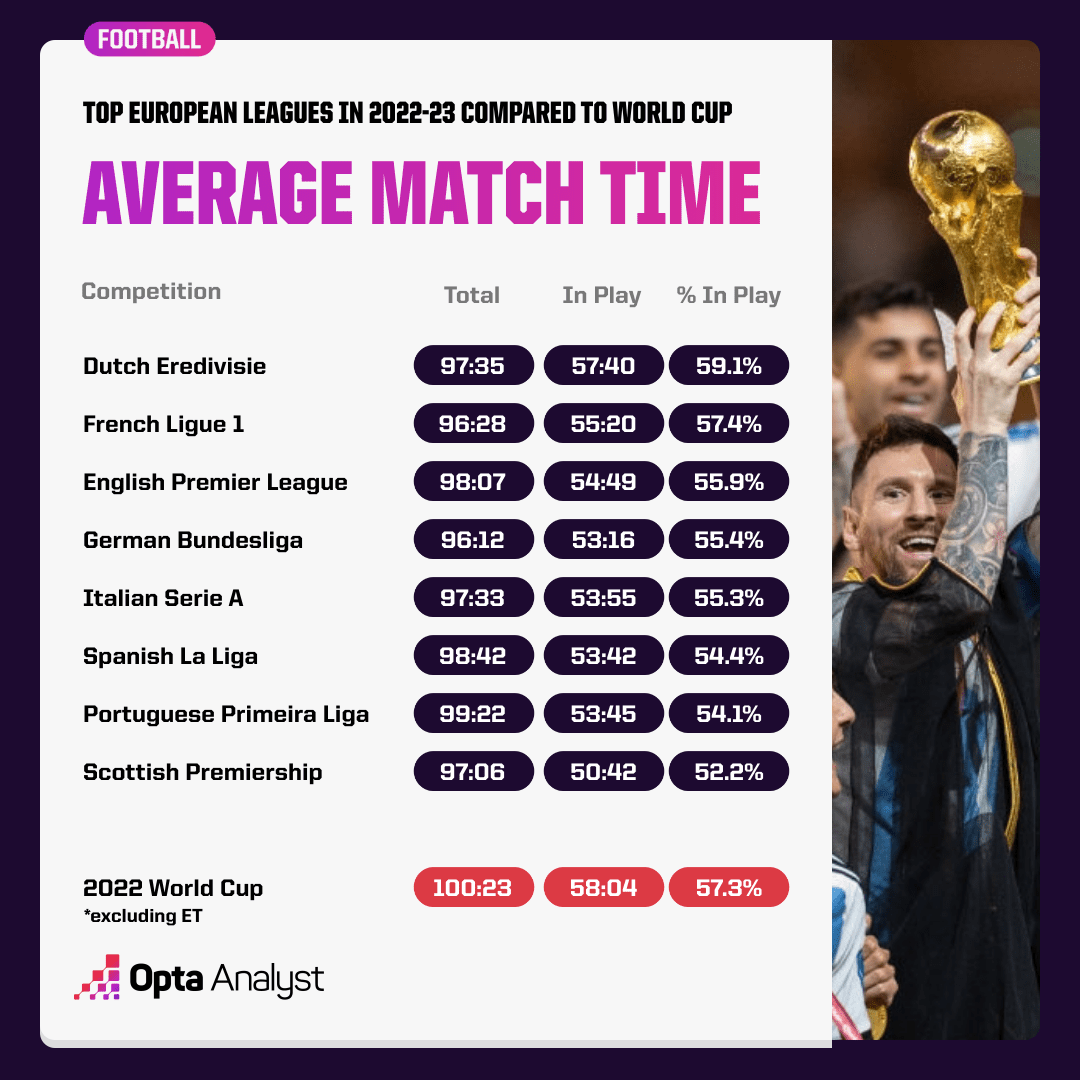
Image Source: theanalyst.com
The Official Time: 90 Minutes and Beyond
The fundamental structure of a football (soccer) match is built around two 45-minute halves. This is the core of the football match duration. However, the concept of “official time” in football is more complex than simply adding up the minutes on the clock.
Standard Halves and the Referee’s Role
Each half of a football match is 45 minutes long. The referee is the ultimate authority on timekeeping. They are responsible for ensuring that each half lasts the full 45 minutes, even if play is interrupted. This is where the idea of “added time” or “stoppage time” comes into play.
Added Time: Compensating for Stoppages
The referee adds time at the end of each half to compensate for:
- Substitutions: The time taken to replace a player.
- Injuries and Treatment: Time spent by medical staff attending to injured players on the field.
- Goal Celebrations: While often brief, significant or prolonged celebrations can be factored in.
- Disciplinary Sanctions: Time taken to show yellow or red cards and administer treatment for fouls.
- Delays in Restarting Play: Examples include players taking too long to take throw-ins or free kicks.
- Video Assistant Referee (VAR) Reviews: Increasingly, decisions reviewed by VAR contribute to added time.
The amount of added time is at the referee’s discretion, but it is typically announced by the fourth official before the end of each half. This added time is crucial for the football game clock not reflecting the true duration of a soccer match.
Half-Time Interval
Between the two halves, there is a mandatory 15-minute half-time interval. During this break, players and officials go to their respective changing rooms. This break is also part of the overall time for a football game, though it’s not active playing time.
Total Football Match Duration (Soccer)
So, when you ask “How long is a football match?”, the official playing time is 90 minutes. However, the actual football match duration can easily extend to:
- First Half: 45 minutes + added time (e.g., 1-5 minutes) = approximately 46-50 minutes
- Half-Time: 15 minutes
- Second Half: 45 minutes + added time (e.g., 2-10 minutes or more) = approximately 47-55 minutes
This brings the total duration of a soccer match from kickoff to the final whistle to roughly 1 hour and 45 minutes to 2 hours. The length of a soccer game is therefore considerably more than its stated playing time.
The American Football Perspective: NFL Game Time
American football, particularly the NFL, operates on a different timekeeping system, and the NFL game duration is famously unpredictable. While a regulation NFL game is divided into four 15-minute quarters, the NFL game time is significantly longer than 60 minutes of play.
Quarters and Halves in American Football
An NFL game consists of four 15-minute quarters. These are divided into two halves, with a half-time break.
- First Quarter: 15 minutes
- Second Quarter: 15 minutes
- Half-Time Break: Typically 13 minutes (can be longer for special events like the Super Bowl).
- Third Quarter: 15 minutes
- Fourth Quarter: 15 minutes
The Crucial Role of Stoppages in NFL Game Time
Unlike soccer, where stoppages are generally added as a lump sum at the end of each half, American football has numerous built-in stoppages that stop the football game clock. These include:
- Incomplete Passes: The clock stops immediately when a pass is thrown and not caught.
- Out of Bounds: The clock stops when the ball carrier goes out of bounds.
- Penalties: The clock often stops during the discussion and administration of penalties.
- Timeouts: Each team has a limited number of timeouts per half, and these stop the clock.
- Scoring: After a touchdown or field goal, the clock is stopped for the extra point attempt or field goal, and for the ensuing kickoff.
- Two-Minute Warning: In the final two minutes of each half, the clock automatically stops.
- Change of Possession: When possession changes (e.g., after a punt or turnover), the clock may stop.
- Injuries: Injuries also lead to clock stoppages.
These frequent stoppages mean that the actual playing time within the 15-minute quarters is much less.
Total NFL Game Duration
Given these numerous stoppages, the NFL game duration is considerably longer than the 60 minutes of scheduled play. A typical NFL game often lasts between 3 hours and 30 minutes to 4 hours, and can sometimes extend even further, especially if there are overtime periods or lengthy reviews. The question “how long does football take” has a very different answer depending on which type of football you are referring to.
Comparing Football Match Durations: Soccer vs. American Football
It’s essential to differentiate between the two major codes of football when discussing football match duration.
| Feature | Soccer (Association Football) | American Football (NFL) |
|---|---|---|
| Scheduled Playing Time | 90 minutes (two 45-minute halves) | 60 minutes (four 15-minute quarters) |
| Timekeeping Mechanism | Running clock with added time for stoppages at the end of halves. | Clock stops frequently for various game events and timeouts. |
| Half-Time Break | 15 minutes | Approximately 13 minutes (can vary) |
| Typical Game Length | 1 hour 45 minutes to 2 hours | 3 hours 30 minutes to 4 hours (or more) |
| Key Stoppages | Injuries, substitutions, goal celebrations, VAR reviews. | Incomplete passes, out of bounds, penalties, timeouts, scores, two-minute warning. |
This table clearly illustrates the vast difference in the length of a soccer game compared to the NFL game duration.
Factors Affecting Soccer Game Length
While the 90 minutes of playing time with added time is standard for soccer, several factors can influence the overall duration of a soccer match:
1. Intensity of Play and Fouls
A match with many fouls and stoppages for treatment will naturally have more added time. Highly physical games or those with a lot of tactical fouling can extend the football match duration.
2. Goal Celebrations
While referees are instructed to limit added time for celebrations, very elaborate or prolonged celebrations can contribute to the overall football match duration.
3. VAR Implementation
The introduction of Video Assistant Referee (VAR) technology has had a noticeable impact on the time for a football game. VAR reviews, whether for penalty decisions, offsides, or red cards, often add to the stoppage time. This can sometimes lead to frustration among fans who feel the duration of a soccer match is becoming too long due to frequent interruptions.
4. Substitutions
The number of substitutions allowed (typically three per team, sometimes more in certain competitions) and the time taken for players to leave and enter the field can add up.
5. Referee’s Judgment
Ultimately, the amount of added time is down to the referee’s discretion. Some referees are more lenient with minor delays, while others are stricter.
Factors Affecting NFL Game Time
The NFL game time is a subject of much discussion, with many viewers feeling it drags on. The primary reasons for this extended NFL game duration are the intentional stoppages built into the game’s design.
1. Offensive and Defensive Strategy
American football is a highly strategic game. Coaches and players use timeouts strategically to discuss plays, disrupt the opponent’s momentum, or give their players a rest. These timeouts are critical for the time for a football game.
2. Incomplete Passes and Out-of-Bounds Plays
The “stop-start” nature of the game is a core element. Every incomplete pass and every time a player steps out of bounds halts the football game clock. This is fundamental to how American football is played and watched.
3. Penalties and Reviews
Penalties are frequent in the NFL, and the process of announcing and enforcing them takes time. Replay reviews, while intended to ensure accuracy, can also significantly lengthen NFL game time.
4. Scoring and Kickoffs
After a touchdown, there’s the extra point or two-point conversion, followed by a kickoff. Each of these events stops the clock and adds to the overall NFL game duration.
5. The Two-Minute Warning
This enforced stoppage in the final two minutes of each half is designed to allow teams to strategize, but it also contributes to the game’s length.
What is the “Real” Length of a Football Game?
When fans ask, “how long does football take?”, they are often curious about the total time commitment.
Soccer’s “Real” Length
For soccer, the football match duration is approximately 1 hour and 50 minutes on average. This includes the 90 minutes of play plus added time and the half-time break. It’s a more predictable timeframe compared to American football.
NFL’s “Real” Length
For American football, the NFL game time is considerably longer. An average NFL game lasts around 3 hours and 12 minutes according to some studies, but many games easily push past the 3.5-hour mark. This includes all the stoppages, timeouts, and breaks. The length of a soccer game is much more compact.
The Football Game Clock: A Different Meaning in Each Sport
The concept of a “football game clock” is interpreted differently in soccer and American football.
Soccer’s Game Clock
In soccer, the referee’s watch is the primary football game clock. While there is a clock visible to spectators and often displayed on screens, it’s the referee who is the official timekeeper. The clock only stops in extreme circumstances (like a temporary abandonment of the match) and is primarily a timer that runs for 45 minutes per half.
NFL’s Game Clock
The NFL utilizes a digital clock that is frequently stopped and started. It’s an integral part of the game’s strategy and pacing. The interplay between the running clock and the stopped clock is a defining characteristic of the NFL game time. The football game clock in the NFL is a dynamic element that directly influences play calling and decision-making.
Final Thoughts on Football Game Length
Whether you’re a fan of the global game or the gridiron, knowing the expected football match duration is important for planning. While soccer offers a more consistent soccer game length, American football’s NFL game duration is known for its variability. The question “how long does football take” is answered differently by each sport, highlighting their distinct temporal structures and gameplay. The duration of a soccer match is generally predictable, while the NFL game time requires a larger time commitment.
Understanding the nuances of added time in soccer and the frequent clock stoppages in American football is key to appreciating the full time for a football game. The length of a soccer game is almost always around the two-hour mark, making it easier to fit into a schedule. The NFL game duration, however, is a much longer affair, often testing the patience of even dedicated fans.
Frequently Asked Questions (FAQ)
How long is a soccer match without added time?
A soccer match officially has 90 minutes of playing time, consisting of two 45-minute halves.
Does the clock stop in soccer?
The clock in soccer generally does not stop for normal stoppages like fouls or substitutions. The referee adds “stoppage time” at the end of each half to compensate for these interruptions.
Why do NFL games take so long?
NFL games take a long time because the game clock stops frequently for incomplete passes, out-of-bounds plays, penalties, timeouts, scoring plays, and the two-minute warning.
Is there a time limit for goal celebrations in soccer?
Referees can add stoppage time for excessive or prolonged goal celebrations, but there isn’t a strict time limit for each celebration.
Can a soccer match end early?
Yes, a soccer match can end early due to extreme weather conditions, crowd trouble, or other unforeseen circumstances, but this is rare and usually results in the match being replayed or abandoned.
How much added time is typical in a soccer match?
Added time in soccer can vary significantly but typically ranges from 1 to 5 minutes per half. In games with many stoppages or VAR reviews, it can be longer.
Is there a maximum duration for an NFL game?
There isn’t a strict maximum duration, but overtime periods can extend the NFL game duration if the score is tied at the end of regulation.
Which sport has a longer game, soccer or American football?
American football (NFL) has a significantly longer game duration than soccer. A typical NFL game is around 3.5 to 4 hours, while a soccer match is around 1.75 to 2 hours.