
You might ask, “How often can I give my toddler Motrin?” You can give your toddler Motrin (ibuprofen) usually every 6 to 8 hours if they need it for fever or pain. But this depends a lot on your child’s weight. Never give it more often than recommended. Always check the dose and timing carefully. Talking to your pediatrician is always the best step.
Giving medicine to a little one can feel tricky. You want to help them feel better fast when they have a fever or hurt somewhere. Motrin, which has the active ingredient ibuprofen, is a common medicine many parents use. It helps lower fever and ease pain. But knowing just how much to give and how often is super important for your child’s safety. Too much medicine can be harmful. Too little might not help them feel better. This guide helps you grasp how to use Motrin safely for your toddler.
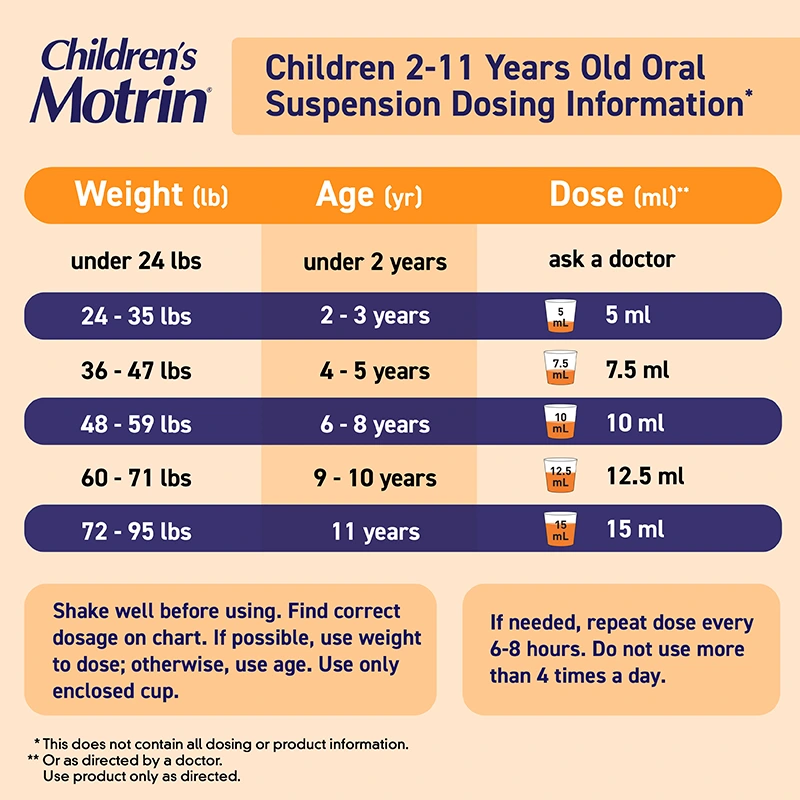
Image Source: images.ctfassets.net
Deciphering Motrin Dosage for Toddlers by Weight
The right amount of Motrin for your toddler is mainly based on how much they weigh. Age is not as good a way to figure out the dose. Why? Because toddlers the same age can weigh very different amounts. A dose that is right for a bigger toddler might be too much for a smaller toddler. A dose for a smaller toddler might not work for a bigger one. That’s why Motrin dosage for toddlers by weight is the key.
When you know your child’s weight, you can find the right dose. Most Motrin packaging for kids has a chart. This chart usually shows weight ranges and the matching dose. If your child’s weight isn’t on the chart, or you are not sure, call your pediatrician. They can tell you the exact right dose.
It is very important to use the right strength of Motrin for kids. Motrin for infants is much stronger than Motrin for children. Giving infant drops using the child dose can lead to an overdose. Always check the product label carefully. Make sure it says “Children’s Motrin” or is for the right age group/weight range. Using the medicine made for babies (infants) can be dangerous if you don’t use the special infant dropper and follow infant directions exactly. For toddlers, you typically use the liquid made for children. It often comes with a special cup or syringe to help you measure.
Grasping How Often to Give Ibuprofen to Toddler
So, you know the dose based on weight. Now, how often can you give it? The usual rule for how often to give ibuprofen to toddler is every 6 to 8 hours. This means if you give a dose at 8 am, you should not give the next dose before 2 pm (6 hours later) or preferably not until 4 pm (8 hours later).
Why wait 6 to 8 hours? Ibuprofen needs time to work in the body. It also needs time to leave the body. Giving it too soon means the level of medicine in your child’s body can get too high. High levels can cause bad side effects. They can even be dangerous. Waiting the full time makes sure the medicine levels stay safe.
It is important to write down the time you give each dose. This helps you keep track. It stops you from accidentally giving it too soon. Use a note on your phone, a piece of paper, or a medicine tracker app.
Remember, you only give the next dose if your child still needs it. If their fever is gone or their pain is much better before 6 hours, you don’t have to give another dose right away. You only give it again if the fever comes back or the pain starts bothering them again after the 6-8 hour window has passed.
Ensuring Safe Frequency for Toddler Motrin
Ensuring a safe frequency for toddler Motrin is not just about the time between doses. It is also about the total amount given in one day. There is a limit to how much ibuprofen a child can have in 24 hours. This limit helps prevent serious problems.
The recommended time between doses helps keep the medicine level stable and safe. Giving it every 6 hours is the minimum time you should wait. Giving it every 8 hours is also fine and might be safer in some cases, especially if your child only has mild symptoms. Always follow the instructions on the medicine box or bottle, and the advice from your pediatrician.
Never guess the dose or the timing. Always use the measuring tool that came with the medicine. A kitchen spoon is not accurate. Giving a little more than the chart says, or giving it a little sooner than 6 hours, might seem harmless. But it increases the risk of problems. Your child’s liver and kidneys have to process the medicine. Giving too much too often puts a lot of stress on these important body parts.
Interpreting the Maximum Motrin Dose for Toddlers in 24 Hours
There is a strict limit on the maximum Motrin dose for toddlers in 24 hours. You should not give your child more than 4 doses of Motrin in a 24-hour period when giving it every 6 hours. If giving it every 8 hours, that would be a maximum of 3 doses. The most common limit is based on the dose given every 6-8 hours, not exceeding 4 doses in 24 hours. However, the exact maximum amount in milligrams (mg) for 24 hours is tied to the child’s weight.
For example, if the correct dose for your child’s weight is 100 mg, the maximum Motrin dose for toddlers in 24 hours would generally be 400 mg (4 doses of 100 mg each). Exceeding this total amount over a 24-hour period can lead to serious health risks.
Think of it like a daily budget for the medicine. Once your child has reached that total amount within one day, you cannot give them any more Motrin until a new 24-hour period begins. This rule is just as important as waiting 6-8 hours between doses. Breaking either rule means your child is getting too much medicine.
Always calculate the total amount given over the past 24 hours before giving a new dose. This is easiest if you keep a log of times and amounts given. If you started tracking at 9 am yesterday, the 24-hour period ends at 9 am today. Add up all the Motrin given between 9 am yesterday and 9 am today. Make sure the total does not go over the limit for your child’s weight. Your pediatrician can tell you the exact maximum mg per kg of body weight per day, which is usually around 40 mg/kg/day, but this is often simplified on packaging to the “no more than 4 doses in 24 hours” rule when using standard dosing frequency. Always rely on the package chart or your doctor’s specific instruction.
Using a Motrin Dosage Chart for Kids
Using a Motrin dosage chart for kids is the clearest way to find the right amount based on weight. These charts are usually printed on the medicine box or bottle.
Here is a general example of what a chart might look like for Children’s Liquid Motrin (often 100 mg per 5 mL):
| Weight (pounds) | Weight (kg) | Age Range (Approximate) | Dose (mL) |
|---|---|---|---|
| 12-17 lbs | 5.5-8 kg | 6-11 months | 1.25 mL |
| 18-23 lbs | 8-10.5 kg | 12-23 months | 1.875 mL |
| 24-35 lbs | 11-16 kg | 2-3 years | 2.5 mL |
| 36-47 lbs | 16.5-21 kg | 4-5 years | 3.75 mL |
| 48-59 lbs | 21.5-27 kg | 6-8 years | 5 mL |
| 60-71 lbs | 27.5-32 kg | 9-10 years | 6.25 mL |
| 72-95 lbs | 33-43 kg | 11 years | 7.5 mL |
Important Notes about this table:
- This is only an example. ALWAYS use the chart on the specific medicine package you have. Different products or brands might have different concentrations (how much medicine is in each mL).
- Age ranges are just a guide. Weight is the main factor.
- The doses listed are single doses. You still need to follow the frequency rules (every 6-8 hours) and the maximum in 24 hours rule.
- If your child’s weight is between ranges, or you are unsure, ask your pediatrician.
Always use the measuring device that comes with the medicine bottle. This might be a syringe, a dropper, or a small cup. These are marked with the correct measurements (like mL – milliliters). Kitchen spoons are not accurate and can lead to dosing errors.
Knowing When to Give Toddler Motrin for Fever or Pain
You might wonder, when to give toddler Motrin for fever or when they are hurting. Motrin is used for two main reasons in toddlers:
- Lowering Fever: A fever is a sign the body is fighting something off. It’s not always bad. Many doctors say you don’t need to treat a fever unless your child is uncomfortable. If your child has a fever but is still playing, drinking, and seems okay, you might not need medicine. But if the fever is high (check with your doctor for what they consider high for your child’s age), or if it makes your child fussy, tired, achy, or not want to drink, then Motrin can help them feel better. The goal is comfort, not just getting the number on the thermometer down.
- Relieving Pain: Motrin can help with mild to moderate pain. This includes aches from a cold or flu, teething pain, earaches (though see a doctor for ear pain), or pain from minor injuries. If your toddler seems to be in pain, and it’s affecting their mood or ability to play/sleep/eat, a dose of Motrin can provide relief.
Always check the temperature before giving fever medicine. This confirms there is a fever. For pain, observe your child’s behavior. Are they holding a body part? Crying more than usual? Not using a limb? These can be signs of pain.
Never give Motrin “just in case” or to prevent a fever from happening (like before a vaccine). Give it only when your child actually has symptoms that need treatment.
Handling a Fever That Doesn’t Break with Motrin
Sometimes, you give your child Motrin, but their fever doesn’t go down much, or it comes back quickly. This can be worrying. What to do if toddler fever doesn’t break with Motrin?
First, double-check the dose and timing. Did you give the right amount for their weight? Did you use the right measuring tool? Was it at least 6-8 hours since the last dose? Was it within the 24-hour limit? Even small errors can make the medicine less effective or unsafe.
If you are sure the dose and timing are correct, and the fever is still high or your child is still very uncomfortable, it’s a sign that the medicine isn’t fully controlling the fever or the cause of the fever is strong.
- Give it time: Motrin can take up to an hour or slightly longer to start working fully. Don’t expect the fever to drop instantly.
- Consider other comfort measures: Offer fluids often. Dress your child in light clothing. Keep the room cool. These can help manage fever alongside medicine.
- Do NOT give another dose of Motrin early: Giving another dose before 6 hours is unsafe, even if the fever is high.
- Consider Alternating (with caution and doctor approval): Sometimes, doctors may suggest alternating Motrin and Tylenol for toddlers for high or stubborn fevers. Tylenol (acetaminophen) is a different medicine that also lowers fever and relieves pain. It works differently than Motrin. You can potentially give Tylenol about 3-4 hours after giving Motrin, and then Motrin about 3-4 hours after giving Tylenol. This allows you to give medicine every 3-4 hours overall, but you are alternating between two different medicines, giving each one less often.
VERY IMPORTANT about Alternating Motrin and Tylenol: This method is complex and increases the risk of dosing errors. It is easy to get the timing or the medicine mixed up. Many pediatricians no longer recommend alternating unless absolutely necessary, because of the high chance of mistakes leading to overdose. NEVER alternate Motrin and Tylenol without specific instructions from your pediatrician. They will tell you if it’s okay for your child, the exact doses for each medicine, and a clear schedule to follow. You need to be extremely careful and keep a detailed log if you do this. It is often safer to just use one medicine and call the doctor if the fever is not well-controlled or your child seems very sick.
If your child’s fever is high, doesn’t come down with the correct dose of Motrin, or your child seems very unwell (not drinking, very sleepy, hard to wake up, having trouble breathing, etc.), call your pediatrician right away. A fever that doesn’t respond well to medicine can sometimes be a sign of a more serious infection.
Recognizing Side Effects of Too Much Motrin Toddler
Giving more Motrin than is safe, either by giving too much at once, giving it too often, or giving too much in 24 hours, can lead to side effects of too much Motrin toddler. Even at the correct dose, some side effects can happen, but they are usually mild. Overdosing increases the risk and severity of problems.
Common side effects at correct doses can include:
- Upset stomach
- Mild nausea
- Vomiting
Signs of getting too much Motrin toddler (overdose) or serious side effects can include:
- Severe stomach pain
- Vomiting blood or stuff that looks like coffee grounds (this means bleeding in the stomach)
- Black, tarry stools (also a sign of stomach bleeding)
- Drowsiness or being hard to wake up
- Fast heartbeat
- Fast breathing
- Less peeing than usual (can be a sign of kidney problems)
- Rash or hives (allergic reaction)
- Swelling of the face, tongue, or throat (allergic reaction)
- Wheezing or trouble breathing (allergic reaction)
- Confusion or strange behavior
- Seizures
If you think you have given your child too much Motrin, or if your child shows any of the serious side effects listed above, get medical help right away. Call your pediatrician, go to the nearest emergency room, or call a poison control center (like 1-800-222-1222 in the US). Do not wait. Bring the medicine bottle with you if possible.
Prevention is the best way to avoid these side effects. Always check the dose, the timing, and the 24-hour limit. Store all medicines up and away, out of your child’s sight and reach.
The Value of Pediatrician Advice on Toddler Motrin
Your pediatrician is your best source of information for your child’s health. Getting pediatrician advice on toddler Motrin is always a good idea, especially the first time you use it or if you have any doubts.
Your doctor knows your child’s health history. They know if your child has any health problems that might make Motrin unsafe, such as kidney issues, stomach problems, or asthma (ibuprofen can sometimes worsen asthma symptoms in some people). They also know about any other medicines your child is taking that could interact with Motrin.
You should definitely call your pediatrician for advice in these situations:
- Your child is under 6 months old. Motrin is usually not recommended for babies younger than 6 months.
- You are unsure about the correct dose for your child’s weight.
- You aren’t sure if your child actually needs Motrin (is the fever high enough? Are they uncomfortable enough?).
- Your child has a fever that is very high (e.g., over 103°F or 39.4°C).
- Your child’s fever lasts for more than 2-3 days.
- Your child has a fever and seems very sick, is hard to wake up, has a stiff neck, trouble breathing, or a strange rash.
- Your child is not drinking well and you worry about dehydration.
- Your child is showing signs of pain that you cannot figure out the cause of.
- You are considering giving Motrin and Tylenol close together (alternating).
- Your child has a bad reaction to Motrin or you think they might have received too much.
- You have any other questions or worries about using Motrin for your child.
Your pediatrician can provide specific dosing instructions tailored to your child and their situation. They can also tell you when it’s better to bring your child in to be seen instead of just treating symptoms at home. Don’t hesitate to call their office.
Key Steps for Safe Motrin Use in Toddlers
Let’s put together the main points for using Motrin safely for your toddler:
- Confirm it’s Motrin (Ibuprofen): Make sure you are giving the correct medicine.
- Use Children’s Strength Liquid: For toddlers, this is usually the right type. Do not confuse it with infant drops or adult medicine.
- Know the Weight: Get an accurate weight for your child.
- Check the Chart: Use the dosage chart on the medicine package based on your child’s weight.
- Measure Carefully: Always use the measuring tool that came with the medicine. Do not use kitchen spoons.
- Wait 6-8 Hours: Give each dose at least 6 hours apart, ideally 8 hours, if needed.
- Watch the 24-Hour Limit: Do not give more than the maximum total amount allowed in any 24-hour period (usually no more than 4 doses).
- Track Doses: Write down the time and amount each time you give a dose.
- Give Only If Needed: Use it for fever that causes discomfort or for pain. Don’t give it just in case.
- Watch for Side Effects: Know what side effects to look for, especially signs of too much medicine.
- Call the Doctor: Contact your pediatrician if you have questions, if the medicine doesn’t help, if your child seems very sick, or if you worry about side effects or overdose.
- Store Safely: Keep medicine locked up, high and away from children.
Using Motrin correctly can help your toddler feel better when they are sick or in pain. Following these safety tips helps make sure you are using it in the best and safest way possible.
Frequently Asked Questions About Toddler Motrin
H4: Can I give my toddler Motrin and Tylenol at the same time?
No, you should not give Motrin and Tylenol at the exact same time. They are different medicines. Giving both at once means your child gets medicine from two sources at the same time. This increases the total amount of medicine in their body at one point, which can be risky. If your doctor suggests alternating them, you give them separately at different times (e.g., Tylenol, then 3-4 hours later Motrin, then 3-4 hours later Tylenol again, and so on), following a strict schedule and ensuring you don’t exceed the 24-hour limit for each medicine. But remember, always talk to your pediatrician before trying to alternate medicines. Many doctors prefer you use just one type of medicine and call them if symptoms are not controlled.
H4: My toddler is 2 years old. Can I just give the dose for a 2-year-old?
It is much safer to base the dose on your toddler’s weight, not just their age. The dosage chart on the Motrin package will list both age ranges and weight ranges. Always use the weight range that matches your child. A small 2-year-old needs less medicine than a large 2-year-old. Using weight ensures they get the right amount for their body size.
H4: What if my toddler spits up the Motrin? Should I give another dose?
This is tricky. If you are sure they spit up all of it right away, you might be able to give one more dose immediately. But if you are not sure how much stayed down, or if they threw up a while after taking it, do NOT give another full dose. Giving too much is dangerous. It’s safer to wait until the next scheduled dose time (at least 6-8 hours after the first attempted dose) to give more, if they still need it. Or, call your pediatrician for advice. They can help you decide if giving another partial dose is safe or if you should wait.
H4: How long does it take for Motrin to work for fever?
Motrin usually starts to work to lower a fever or relieve pain within 30 to 60 minutes. It can take up to an hour or slightly more to see the full effect. Don’t expect the fever to disappear completely, but you should hopefully see it go down a bit and, more importantly, your child should start to feel more comfortable.
H4: Can I give Motrin for teething pain?
Yes, Motrin can be used to help ease teething pain in toddlers if they seem uncomfortable. Follow the correct dosing instructions based on their weight and the frequency rules (every 6-8 hours). It’s usually given when the pain seems to be bothering them, like making them fussy, irritable, or affecting their sleep or eating.
H4: What if I accidentally give a little too much Motrin?
If you think you gave a dose that was slightly over the recommended amount for your child’s weight, but it was only a tiny bit more, watch your child carefully for any signs of the side effects mentioned earlier (stomach pain, vomiting, drowsiness, etc.). If they seem fine, just be extra careful with the next doses. However, if you gave significantly too much, or if your child shows any worrying symptoms, call your pediatrician, the nearest emergency room, or poison control (1-800-222-1222) right away. It is always best to call if you are unsure. They can tell you what to do based on the amount given and your child’s weight.
H4: How long can I keep giving Motrin for a fever or pain?
You should typically only give Motrin for a few days for common issues like fever from a cold or minor pain. For fever, don’t give it for more than 3 days unless your pediatrician tells you to. For pain, don’t give it for more than 5-7 days unless your pediatrician tells you to. If your child still needs Motrin after this time, it means there might be an ongoing problem that needs a doctor’s attention. Long-term use of ibuprofen can sometimes cause stomach issues or kidney problems.
Disclaimer: This blog post provides general information only and is not medical advice. Always consult with your pediatrician regarding any health concerns, diagnoses, or before starting or changing any treatment, including giving medication to your child. The dosage chart provided is an example and you must always follow the instructions and dosage chart on the specific medicine package you are using, and preferably confirm the dose with your doctor.